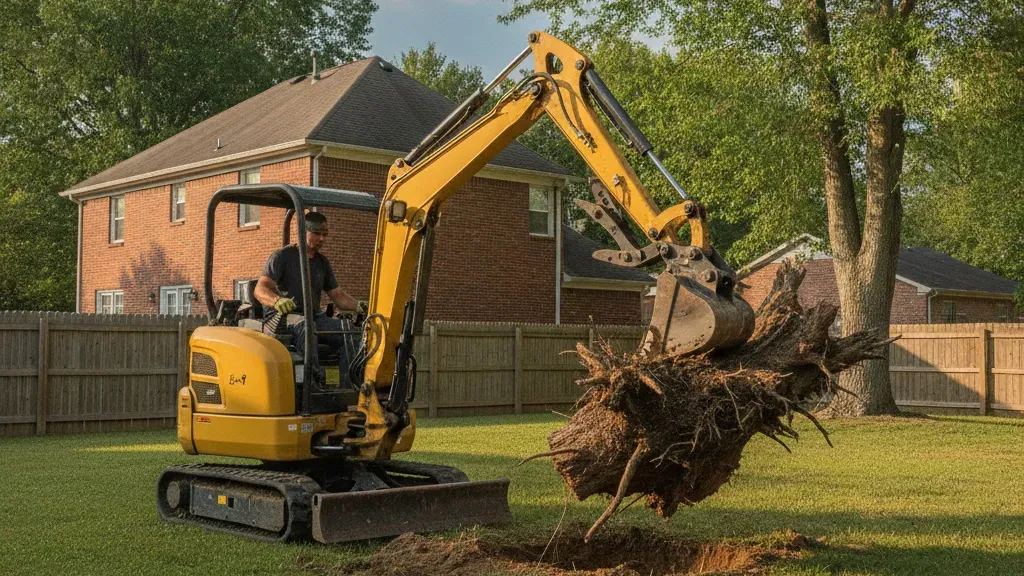
Excavator stump removal digs the stump and much of its main root mass out of the ground, leaving a hole to backfill and grade. Stump grinding chews the stump down below the surface and leaves the roots in place, along with a pile of wood chips. Removal clears the ground for trenching, drainage, or grading. Grinding is a different job, with a different machine.
Lawn Busterz offers excavator work: trenching, digging, stump removal, and drainage prep. Stump grinding is not on our published service menu. This page explains the difference so you can tell which job you actually need, and what to plan for after the stump is gone.
What an excavator does to a stump
An excavator uses its bucket to dig around the stump, break the main roots, and lever the stump and root ball out of the ground. Depending on the size of the stump and the soil, that typically means:
- The stump comes out whole or in large pieces.
- Major roots near the stump are pulled or cut.
- A hole is left where the root ball sat.
- The stump and debris can be loaded and hauled off.
- The hole can be backfilled and graded.
This is the better fit when you need the ground itself, not just a flat surface: a trench line that runs through the stump, a French drain route, a regrade, a gravel pad, or a spot where something will be built.
What stump grinding does
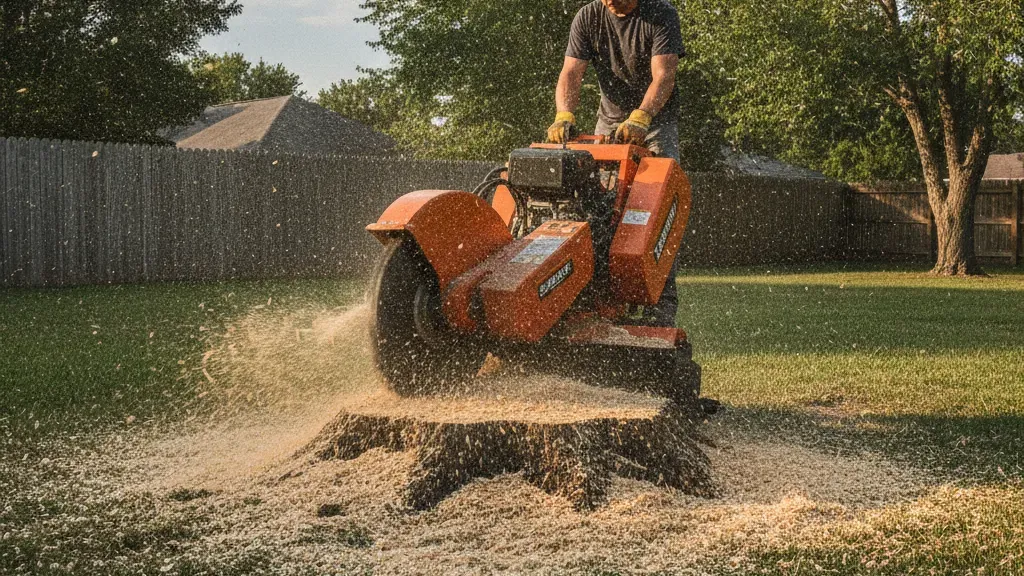
A stump grinder is a separate machine with a spinning cutting wheel. It grinds the stump into chips, usually down to several inches below grade. What it leaves:
- Roots stay in the ground and decay over time.
- A pile of wood chips, which may be spread, used as fill, or hauled.
- A shallow depression after the chips settle and break down.
Grinding is often chosen when the goal is a flush surface for mowing or a seeded patch, and nothing needs to be dug in that spot. It disturbs less soil and leaves the surrounding lawn more intact.
Lawn Busterz does not list stump grinding. If grinding is the job you want, a stump grinding company is the right call. If the stump is in the way of digging, grading, or drainage, that is where excavator removal fits.
When the real job is a trench or drainage
Many stump questions are really drainage or grading questions. A stump sits on the line where a French drain needs to run, or in a low spot that needs to be regraded, or in the way of a gravel pad. Grinding would leave roots in the trench path and a soft spot where the chips decay. Excavator removal clears the path so the trench, pipe, and gravel can go in properly.
Lawn Busterz uses the excavator for exactly this kind of work: trenching, digging, stump removal, and drainage prep, done clean.
What is left after excavator removal
Ask about these before the work starts:
- The hole. Removing a root ball leaves a hole roughly the size of the root mass. It needs to be backfilled with soil and compacted or allowed to settle.
- Roots. Large roots near the stump come out; fine roots farther away usually stay and break down.
- Debris. The stump, roots, and soil clods. Confirm whether haul-off is in the quote.
- Grade. The area should be graded so it does not become a new low spot that holds water.
- Lawn damage. Machine tracks can mark the lawn around the work area, especially on soft clay.
Why seed or sod should wait
New seed or sod over a freshly backfilled stump hole often fails. The fill settles over the following weeks and rains, leaving a depression that holds water. On Central Kentucky clay, that low spot can stay soggy and kill new grass. Let the fill settle, top it up and regrade if needed, and then plan seed or sod. In this region, late summer into early fall is usually the best seeding window for tall fescue. Seeding and sod are not on the current Lawn Busterz menu, so confirm who will handle that step.
Access the machine needs
An excavator needs room to get to the stump and work around it:
- Gate width and clear path from the driveway or street to the work area.
- Firm ground. Saturated clay can rut badly under tracks. Dry weather helps.
- Overhead clearance from limbs, lines, and eaves.
- Utilities marked. Call 811 before any digging, and point out private lines such as water, electric to outbuildings, or irrigation.
- Septic. Mark the tank and drain field so equipment stays off them.
Excavator removal vs grinding: quick comparison
| Excavator removal | Stump grinding | |
|---|---|---|
| Stump | Dug out | Ground to chips below grade |
| Roots | Main roots removed | Left in the ground |
| Leaves behind | Hole to backfill and grade | Chips and a shallow depression |
| Best for | Trenching, drainage, grading, pads | Flush surface for lawn |
| Lawn Busterz | On the published menu | Not on the published menu |
Request an excavator walk-through
Lawn Busterz serves Richmond, Lexington, Berea, Winchester, Nicholasville, Mount Sterling, Stanford, Danville, Lancaster, and surrounding Central Kentucky. Tell us how many stumps, roughly how large, and what you want to do with the ground afterward. Final pricing comes after a walk-through.
Call (859) 248-0576 or email hello@lawnbusterzky.com">hello@lawnbusterzky.com. Hours are Mon to Sat, 7a to 7p.