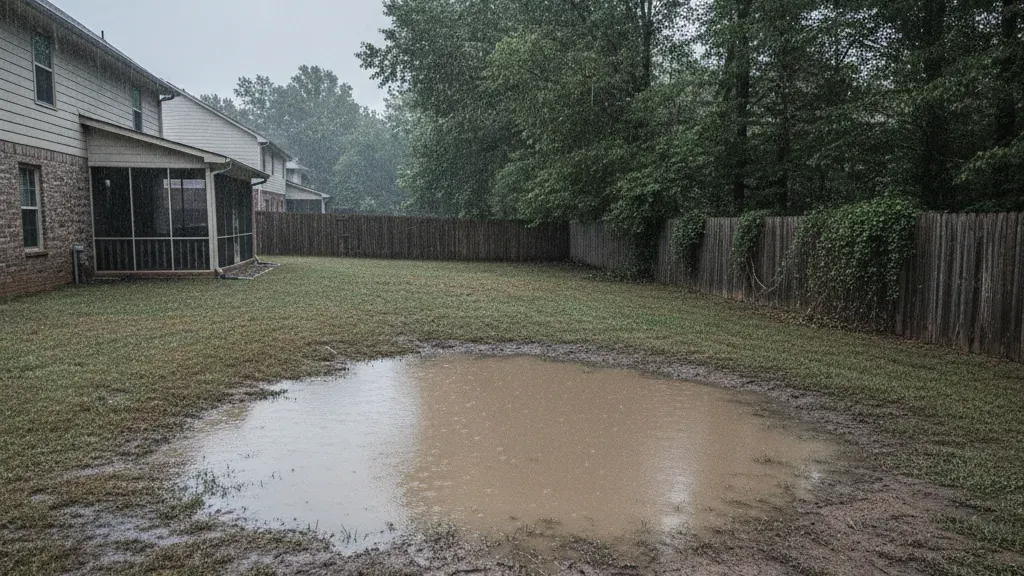
Not every soggy yard needs a French drain. If water sheets across the surface into a low spot, grading usually fixes it. If water collects at one point, a catch basin can gather it. If the ground stays saturated below the surface, a French drain fits. If a downspout is the source, an extension may be all you need. Every option needs a working outlet.
Lawn Busterz installs French drains with perforated pipe, gravel, and filter fabric, plus catch basins and downspout extensions, and offers skid steer grading and excavator drainage prep. This guide walks through how to read the problem first, so the fix matches the water instead of the other way around.
Start with four clues: source, path, low point, outlet
Before picking a fix, answer four questions. The best time to look is during or right after a hard rain.
- Source. Where does the water come from? A downspout, a neighbor's slope, a driveway, a patio, or the ground itself staying wet.
- Path. How does it move? Sheeting across the surface, running in a channel, or seeping up from below.
- Low point. Where does it end up? A specific dip in the lawn, along the foundation, at the bottom of a slope, or spread across a whole area.
- Outlet. Where could it go? A lower part of the property, a ditch, a street, or a daylight point where a pipe can safely discharge.
Write down how long the water sits after rain. A puddle gone in a few hours is different from a spot that stays wet for days.
When the problem is surface grade
Grading is the right first answer when water flows across the surface and collects in a low spot. Signs include:
- Water runs toward the house instead of away from it.
- A dip in the lawn fills every rain and drains slowly.
- The yard slopes back toward the foundation.
- Runoff from a driveway or patio flows across the lawn into one area.
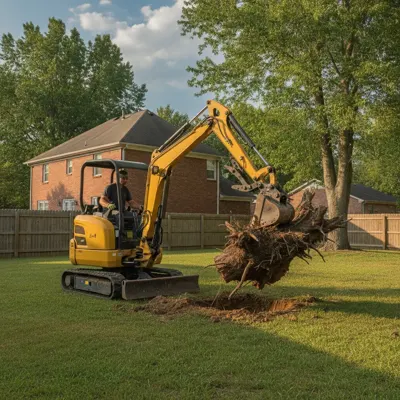
Regrading reshapes the ground so water moves where you want it, often with a gentle slope away from the house or a shallow swale that carries water to an outlet. Lawn Busterz does this with a skid steer, including leveling and filling low areas.
When a catch basin makes sense
A catch basin is a box set in the ground with a grate on top, connected to a solid pipe. It collects surface water at a single point and carries it away underground. It fits when:
- Water collects at one predictable spot, such as the bottom of a slope or the corner of a patio.
- Downspouts need a place to tie in underground.
- Surface water needs to cross a lawn area without sheeting across it.
A catch basin handles water that arrives on the surface. It does not dry out soil that is saturated below.
When a French drain fits
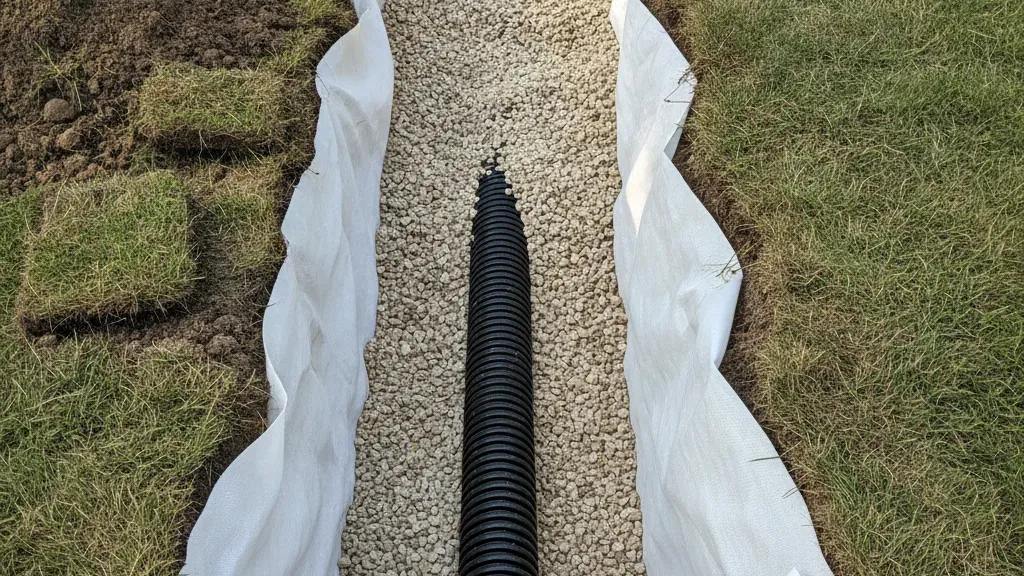
A French drain is a trench lined with filter fabric, filled with gravel around a perforated pipe. Water in the soil seeps into the gravel, enters the pipe, and flows to an outlet. It fits when:
- The ground stays soggy for days even without surface pooling.
- Water seeps along a slope or comes up from below.
- A broad wet area has no single collection point.
- Runoff needs to be intercepted along a line, such as the uphill side of a yard.
Central Kentucky clay matters here. Clay soils drain slowly, so water lingers near the surface. A French drain gives that water a faster path out, as long as the pipe can reach a lower outlet.
When a downspout extension is enough
Roof water is one of the most common causes of soggy beds and side yards. A single downspout can dump a large volume of water in one spot every storm. If the wet area sits right below a downspout, extending it to discharge farther from the house, or tying it into an underground line or catch basin, may solve the problem without any other work.
The outlet decides whether any of it works
Every drainage fix has to send water somewhere lower. If there is no outlet with enough fall, a French drain or catch basin just fills up. Before you commit to digging, confirm:
- There is a point lower than the problem area where water can discharge.
- The discharge will not send water onto a neighbor's property or into a spot that causes new trouble.
- The route from the problem to the outlet is clear of utilities and septic. Call 811 before digging.
Also watch for sinkhole clues. Central Kentucky has karst terrain, and a depression that is growing or a hole that opens suddenly should be evaluated before anyone directs water toward it.
Why sod, seed, or mulch fails when water is ignored
New sod laid over a low spot drowns. Seed in a soggy patch rots or washes out. Mulch in a bed below a downspout floats away. If the water path stays the same, the new surface will fail in the same place. Fix the water first, then restore the lawn or beds.
Matching the clues to the fix
| What you see | Likely fix |
|---|---|
| Water flows across the surface into a dip | Grading or a swale |
| Water collects at one spot | Catch basin |
| Ground stays soggy below the surface | French drain |
| Wet area right below a downspout | Downspout extension or tie-in |
| More than one of the above | A combination |
Many properties need more than one fix, such as regrading a slope and adding a catch basin at the bottom.
What it costs
For published price ranges on French drain installation, see the Lawn Busterz French drain cost FAQ; the final number comes from a walk-through.
Get a drainage walk-through
Lawn Busterz serves Richmond, Lexington, Berea, Winchester, Nicholasville, Mount Sterling, Stanford, Danville, Lancaster, and surrounding Central Kentucky. Photos taken during or right after rain, plus notes on how long water sits, help us see the problem quickly.
Call (859) 248-0576 or email hello@lawnbusterzky.com. Hours are Mon to Sat, 7a to 7p.